
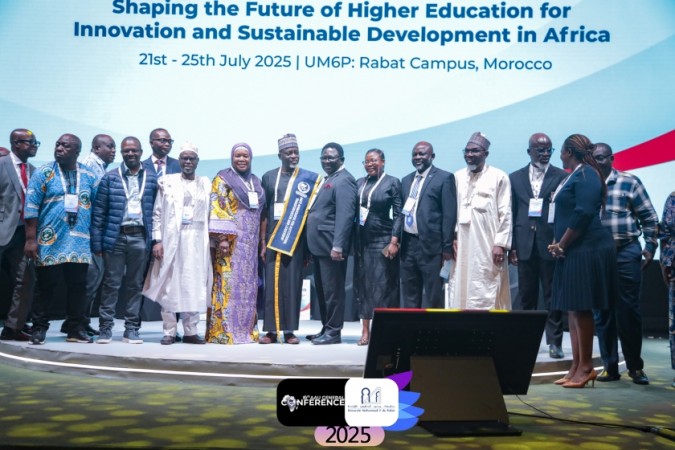
African universities have collectively charted a bold new direction for the future of higher education following the 16th General Conference of the Association of African Universities (AAU), held from July 21–25 at the University Mohammed VI Polytechnic (UM6P) in Morocco.
The five-day summit brought together nearly 500 delegates, including vice-chancellors, policymakers, researchers, and development partners, under the theme “Shaping the Future of Higher Education for Innovation and Sustainable Development in Africa.”
In his opening address, Prof. Hicham El Habti, President of UM6P, urged institutions to evolve into “living laboratories” that serve as engines of societal impact. “Collaboration and resilience are no longer optional; they are our lifelines,” he told participants, setting the tone for the transformative discussions that followed.
The conference featured 12 plenary sessions and a series of side discussions tackling pivotal topics such as digital transformation, institutional innovation, gender equity, and research sovereignty. A key announcement was a continent-wide call for research papers led by the African Union Commission for Human Resources, Science and Technology (AUC-HRST) and AAU, with backing from the Mastercard Foundation.
The call, themed "Gender Equality and Education: Transforming Education Systems in Africa for Gender Equality," aims to unearth bold, research-driven solutions to entrenched disparities. The top 10 papers will be published and presented at a high-level AU side event in 2026, with fully sponsored participation.
“This initiative is not just academic—it’s about transforming lives,” said Prof. Olusola Oyewole, Secretary-General of AAU. “We are calling on scholars and practitioners to reimagine education through the lens of gender equity and inclusion.”
In a significant step toward reclaiming African academic agency, delegates endorsed the Diamond Open Access (DOA) model and committed to scaling the African Platform for Open Scholarship (APOS). The platform is envisioned as a vehicle to dismantle barriers to African-generated research and promote the use of indigenous languages in scholarly publishing.
Meanwhile, sobering statistics on access for marginalised groups drew sharp focus. Currently, just 1% of people with disabilities and 3% of displaced youth are enrolled in African universities. Delegates are committed to raising this figure to 15% by 2030, a move hailed as vital to ensuring innovation is rooted in inclusivity.
The conference lauded the Africa Higher Education Centres of Excellence (ACE) initiative, which has produced over 100,000 postgraduates, 10,000 research outputs, and numerous public-private partnerships in its first decade. The initiative is being positioned as a replicable model for regional transformation.
Concrete resolutions adopted at the conference include:
-
Scaling Open Access and APOS to at least 20 institutions by 2026
-
Embedding AI and digital literacy into all curricula
-
Expanding inclusive enrollment policies
-
Professionalising research ecosystems across Africa
-
Institutionalising youth innovation platforms
-
Harmonising African credit transfer systems to boost academic mobility
These measures align with the Continental Education Strategy for Africa (CESA 2026–2035) and the new TVET Strategy (2025–2034). To track progress, the AAU announced a high-level monitoring task force, supported by the AU, UNESCO, and the Mastercard Foundation.
A highlight of the conference was the election of Professor Kenneth Kamwi Matengu, Vice Chancellor of the University of Namibia, as the 14th President of the AAU Governing Board, garnering 67.1% of the member votes. In his acceptance speech, Matengu called for the harmonisation of African higher education through a unified credit transfer system to enhance continental academic mobility.
“This conference is a call to action,” Prof. Oyewole concluded. “Our universities must become engines of innovation, equity, and resilience. The future of Africa’s youth—and the continent itself—depends on it.”
As the curtains fell on the AAU’s 16th General Conference, participants departed with renewed resolve to elevate African universities as global hubs of inclusive, innovative, and sustainable education.
Article by Jed Mwangi
Photo/Google
Comment