
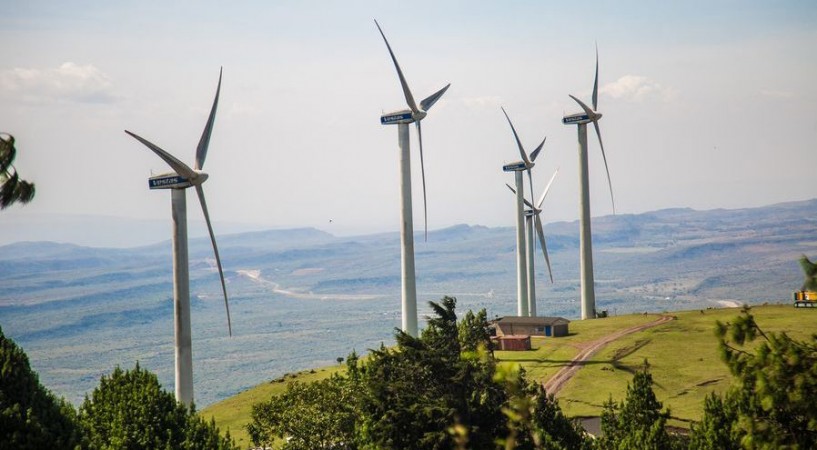
 Ngong Hills Power Station in Kenya
Europe has moved decisively to strengthen its role in Africa’s clean-energy future, rallying more than €15.5 billion in public and private commitments through a year-long investment campaign co-led by European Commission President Ursula von der Leyen and South African President Cyril Ramaphosa. While the headline number is significant, analysts say the campaign’s deeper impact lies in how it reshapes global energy partnerships, development priorities, and the geopolitics of the green transition.
The initiative developed with Global Citizen and supported by the International Energy Agency, aimed to mobilise capital for renewable energy infrastructure, electrification, and green industrialisation across Africa. With the European Union pledging €15.1 billion, including more than €10 billion under Team Europe’s Global Gateway strategy, Europe has clearly signalled that Africa’s energy transition is strategically linked to its own global ambitions.
As Africa prepares to triple renewable energy capacity and expand electricity access for 600 million people without reliable power, global competition for influence in the continent’s energy sector has intensified. Europe’s coordinated investment push positions it as a central partner in Africa’s transition at a moment when China, the Gulf states, and new climate-finance coalitions are expanding their footprint.
By leading the pledging effort, the EU is not only reinforcing development cooperation but also advancing its geopolitical interests: securing future green value chains, strengthening trade relations, and supporting African countries’ shift toward decarbonised manufacturing.
President von der Leyen described the outcome as a “surge of opportunity,” emphasising that enhanced clean-energy capacity will unlock new jobs, markets, and industrial pathways for African economies. “This investment is real, life-changing power for communities,” she said.
The €15.5 billion package reflects a deeper shift from traditional aid to blended finance and structured partnerships. Team Europe’s contributions include:
- Major Global Gateway projects jointly financed by Germany, France, Denmark, Italy, the Netherlands, Spain
- €2.1 billion from the European Investment Bank
- €740 million from the European Bank for Reconstruction and Development
- More than €5 billion in bilateral contributions from Italy, Germany, Denmark, Portugal, Sweden, Austria, Ireland, and the Netherlands (including FMO)
These commitments aim to unlock private-sector investment by reducing risk and improving policy frameworks an approach aligned with Africa’s push for equitable climate finance and sovereign energy autonomy.
The pledges already include commitments capable of delivering:
- 26.8 GW of new renewable energy generation, and
- Electricity access for 17.5 million households currently lacking reliable power.
Of particular significance is the African Development Bank’s pledge to dedicate at least 20% of the African Development Fund’s next cycle to renewable energy, an institutional shift that could influence long-term energy financing across the region.
Launched in November 2024 in Rio de Janeiro, the “Scaling Up Renewables in Africa” campaign was designed to support African countries’ clean-energy ambitions while contributing to global COP28 goals: tripling renewable capacity and doubling energy efficiency by 2030.
For African leaders, the campaign provides a platform to diversify energy partnerships, build green manufacturing hubs, and accelerate a just transition away from fossil fuels. For Europe, it represents a critical step in deepening political ties and securing mutually beneficial green value chains from hydrogen to critical minerals to renewable-powered industrial zones.
With EU institutions indicating plans to scale up renewable-energy investments by an additional €4 billion by 2030, the campaign marks a strategic reset in how Europe engages with Africa, as a critical partner in the global green transition.
Article by RB Corespondent
Photo courtesy / Kengen
https://ec.europa.eu/commission/presscorner/detail/en/ip_25_2781
Comment