
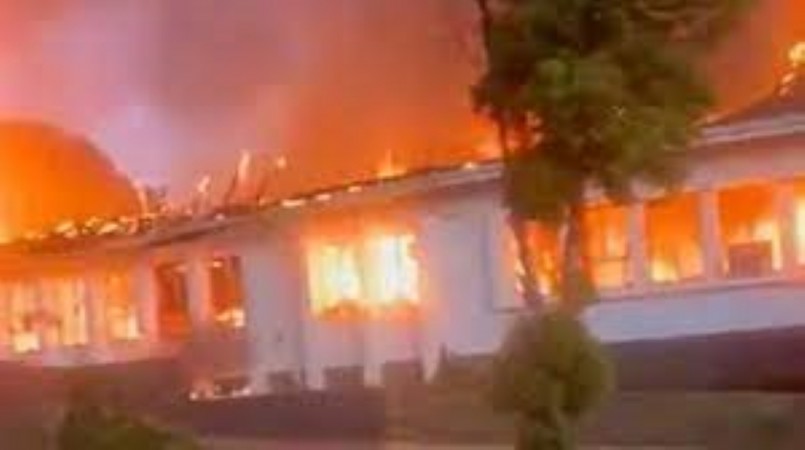
The University of Fort Hare, one of South Africa’s most storied academic institutions, is reeling from a devastating fire that swept through its Alice campus during student protests, wiping out years of scientific research and exposing deep vulnerabilities in Africa’s research infrastructure.
The blaze, which broke out on 7 October amid demonstrations over governance and administrative issues, gutted several major university buildings — including the Faculty of Science and Agriculture’s laboratories, the main administration block, and a newly constructed campus clinic. Initial estimates place the damage between R300 million and R500 million (US$16–27 million).
For many researchers, however, the losses extend beyond physical infrastructure. Entire archives of scientific data, field samples, and long-term experiments — representing decades of collective effort — have been reduced to ashes.
“It’s not just infrastructure,” said Professor Linda Sibali, Dean of Science and Agriculture. “We’ve lost years of irreplaceable data. Our academic rhythm has been broken.”
The agriculture faculty, which had recently undergone a US$1.1 million laboratory upgrade, was among the worst affected. Professor Ishmael Jaja, a researcher in pasture science, said five to six years of field data were destroyed in the fire.
“We had samples representing the evolution of local pasture systems — data vital to food security research. It’s all gone,” he lamented.
The incident underscores a recurring crisis in African higher education, where student protests — often triggered by governance disputes, funding delays, or socio-economic inequality — can derail academic progress and research continuity. Similar disruptions have been reported at Kenya’s University of Nairobi, Nigeria’s University of Ibadan, and other regional institutions.
“This isn’t an isolated case,” noted Dr Nandi Maseko, an education policy analyst. “African universities are under mounting financial and political pressure. When protests escalate, it’s research that pays the highest price.”
The Fort Hare tragedy also reveals structural weaknesses in research management across the continent, including inadequate insurance coverage, poor data protection, and limited disaster preparedness. Few universities in Africa maintain digital archives or off-site data backups, leaving years of scientific work vulnerable to fire, theft, or power instability.
In the aftermath, university officials have pledged to ensure academic continuity, announcing plans to move some classes online and to relocate affected students and staff. However, experts warn that rebuilding the destroyed laboratories and restoring Fort Hare’s full research capacity could take up to two years.
Founded in 1916, the University of Fort Hare has long been a symbol of African intellectual heritage, counting leaders such as Nelson Mandela, Oliver Tambo, and Seretse Khama among its alumni. The recent disaster, observers say, serves as both a warning and a wake-up call for the continent’s universities to invest in research resilience, data preservation, and campus security.
Article by Jed Mwangi
Photo/Google
Comment