
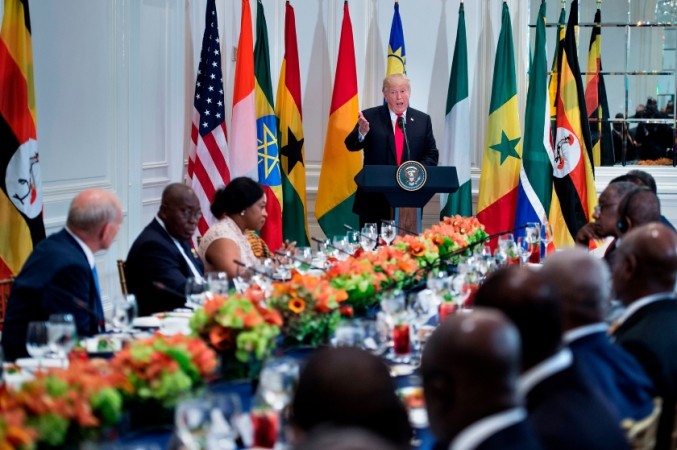
The United States government has introduced sweeping new restrictions on research grants and foreign assistance, raising alarm among African scientists and policymakers who fear the measures could undermine decades of scientific collaboration.
Signed by President Donald Trump on August 7, 2025, the executive order — titled “Improving Oversight of Federal Grantmaking” — gives political appointees the final say on all new federal research grants. The White House argues the changes will curb waste and ensure U.S. taxpayer funds align with “American values” and “national interests.”
But critics warn the move shifts decision-making away from scientific merit and toward political ideology. Grants can now be revoked mid-project if deemed politically inconsistent, while entire areas of research — including racial equity, gender studies, immigration, and work seen as “anti-American” — have been barred from funding.
“This fundamentally undermines peer review,” said a senior researcher at a Nairobi medical institute who requested anonymity. “Even groundbreaking proposals could be blocked for reasons that have nothing to do with science.”
For decades, U.S. agencies such as the National Institutes of Health (NIH), National Science Foundation (NSF), and USAID have funded African-led projects tackling malaria, HIV/AIDS, tuberculosis, maternal health, and climate adaptation. These partnerships have trained thousands of scientists and built vital infrastructure across universities and research centres.
Experts warn that the new rules could jeopardise these gains by introducing uncertainty into multi-year projects. “The ability of political officials to cancel grants ‘for convenience’ creates instability that undermines planning and long-term research,” said Dr. Lydia Moyo, a policy analyst at the African Academy of Sciences.
The order’s broader implications extend to U.S.-funded development programs that address healthcare inequalities, education gaps, and livelihoods. By banning support for initiatives that confront racial inequities or systemic disparities, many fear vulnerable African communities will be left behind.
At the same time, some analysts believe the policy could accelerate a realignment in research funding. European programs like Horizon Europe, China’s growing research partnerships, and philanthropic organisations such as the Gates Foundation and Wellcome Trust may take on greater importance. “This is both a challenge and an opportunity,” said Professor James Okello, a Ugandan epidemiologist. “Africa must strengthen regional collaboration and reduce over-reliance on one funding partner.”
While the order pledges to simplify grant applications and expand access to new institutions, experts note that compliance with political restrictions may create new bureaucratic hurdles that underfunded African universities struggle to meet.
Beyond the financial risks, scholars see a threat to academic freedom. By excluding studies on migration, colonial history, and racial health disparities, the new policy could silence African researchers working on sensitive but essential issues.
The timing, experts note, could not be worse. With global challenges such as pandemics, antimicrobial resistance, and climate change demanding international cooperation, the politicisation of U.S. grantmaking threatens to erode trust in cross-border science networks.
Article by Nyokabi Wanjiku
Photo/Google
Comment