
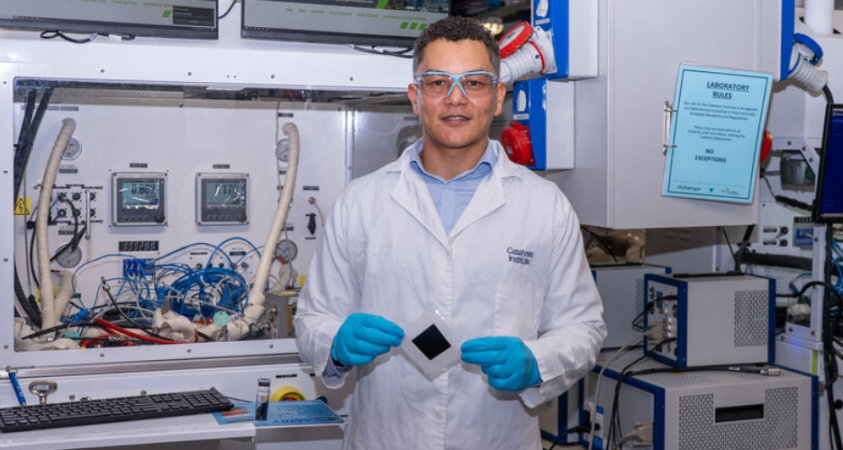
 Photo of Assoc Prof Rhiyaad Mohamed who believes that Africa can be at the global forefront of critical green hydrogen technology research
The University of Cape Town (UCT) has secured a place in a global research effort aimed at addressing one of the biggest material constraints facing the expansion of green hydrogen, after Associate Professor Rhiyaad Mohamed was selected among just 11 researchers worldwide for the 2026 EQT Foundation Critical Minerals Science Grant.
UCT is the only African institution represented in this year’s cohort, highlighting the growing role of South African research in developing technologies needed for the global clean energy transition.
The grant will support Professor Mohamed’s work at the UCT Catalysis Institute to develop ultra-low-iridium anodes for proton exchange membrane (PEM) water electrolysers. The research seeks to reduce the amount of iridium needed to produce green hydrogen without sacrificing the performance or durability of electrolysers.
Mohamed’s research is therefore focused on making each atom of iridium work harder.
The project will explore new approaches to dispersing and supporting iridium in catalyst structures, with researchers seeking to substantially lower its use while maintaining the performance required for commercial electrolysers.
The EQT Foundation funding will support advanced materials synthesis, catalyst development, electrode fabrication and electrochemical testing at UCT.
Researchers will also work to translate promising laboratory results into membrane-electrode assemblies that can be manufactured consistently and tested under realistic operating conditions.
The longer-term ambition is to demonstrate a more resource-efficient approach to PEM water electrolysis that could help remove one of the material bottlenecks limiting large-scale green hydrogen deployment.
For Mohamed, the international recognition also reflects years of investment in South Africa's hydrogen research ecosystem.
He credited the researchers and students at the UCT Catalysis Institute and the Hydrogen South Africa (HySA) Catalysis Centre of Competence, as well as sustained support from South Africa’s Department of Science, Technology and Innovation through the HySA programme.
The programme, implemented with support from the South African National Energy Development Institute, has helped build national expertise in hydrogen technologies and advanced electrocatalysis over more than 15 years.
The project also carries a broader ambition: ensuring that African countries participate in developing the technologies underpinning the energy transition rather than remaining primarily suppliers of raw materials.
South Africa has particular advantages, including expertise in platinum-group metals, established scientific institutions and significant renewable energy potential.
Mohamed said the country has an opportunity to move further up the value chain by developing catalysts, manufacturing components, integrating electrolysers and commercialising technologies.
The research aligns with South Africa’s Hydrogen Society Roadmap, which seeks to use hydrogen technologies to support industrial development, job creation and a just transition towards a lower-carbon economy.
Beyond the scientific work, the project will train postgraduate students and emerging researchers in electrocatalysis, advanced materials, electrochemical engineering and hydrogen technologies.
Article by Jed Mwangi
photo courtesy of University of Capetown
https://www.news.uct.ac.za/article/-2026-08-12-uct-researcher-earns-prestigious-global-science-grant
Comment