
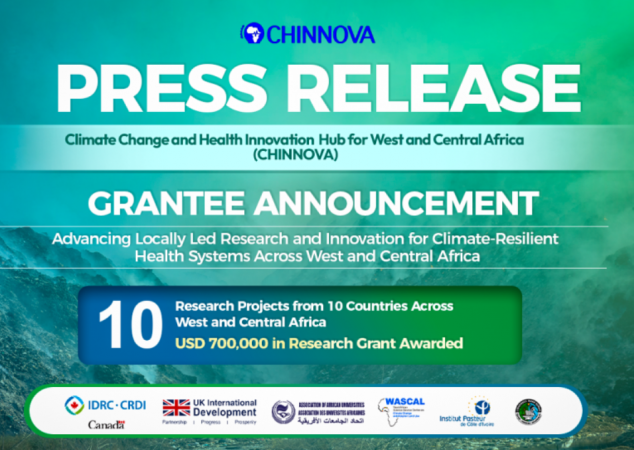
Ten research teams across West and Central Africa are set to receive a combined US$700,000 to develop locally led solutions to the growing health threats posed by climate change.
The funding, awarded through the Climate Change and Health Innovation Hub for West and Central Africa (CHINNOVA), follows one of the region’s most competitive recent calls for climate and health research. More than 300 expressions of interest and over 200 full proposals were submitted, highlighting the growing demand for research addressing the intersection of climate change and public health.
The 10 successful projects bring together researchers and institutions from Benin, Cameroon, Côte d’Ivoire, the Democratic Republic of Congo, The Gambia, Gabon, Ghana, Liberia, Senegal and Sierra Leone.
Rather than concentrating funding in a small number of established research centres, the programme provides support to a broad mix of organisations across Francophone and Anglophone Africa. The approach is intended to strengthen regional research capacity while ensuring that solutions are shaped by communities facing climate-related health risks.
The funded projects will investigate challenges including climate-sensitive disease surveillance, heat stress, digital health, gender equity and community resilience. Their findings are expected to provide evidence that can help governments strengthen health systems and develop policies capable of responding to changing climate conditions.
The grants were awarded following an independent assessment of proposals based on scientific and technical quality, relevance to regional priorities, potential impact, team composition, gender considerations and budget feasibility.
The successful institutions include Green Scenery Sierra Leone; École Polytechnique de Thiès in Senegal; Université des Sciences et Techniques de Masuku in Gabon; Ghana’s Council for Scientific and Industrial Research; Official University of Semuliki in the Democratic Republic of Congo; Water Resources Liberia; the Society for the Study of Women’s Health in The Gambia; SODEXAM in Côte d’Ivoire; the Research Center for Global Health Action on Climate Change, Gender Equity, and Emerging Diseases in Benin; and the University of Bertoua/Osu Foundation in Cameroon.
The scale of interest in the funding call, according to the Association of African Universities (AAU), demonstrates both the strength of scientific capacity in the region and the urgency of addressing climate-related health risks.
“The strong response to this call is a clear signal that institutions across West and Central Africa are ready and equipped to lead on climate and health,” said Prof. Frederick Ato Armah, Director of Research and Programmes at the AAU.
He said CHINNOVA would help translate that capacity into research capable of informing policy, strengthening health systems and protecting vulnerable communities.
CHINNOVA is led by the Association of African Universities in partnership with the West African Science Service Centre on Climate Change and Adapted Land Use (WASCAL), Institut Pasteur de Côte d’Ivoire and Université Omar Bongo.
Photo courtesy: Association of African Universities
Article by Jed Mwangi
Comment