
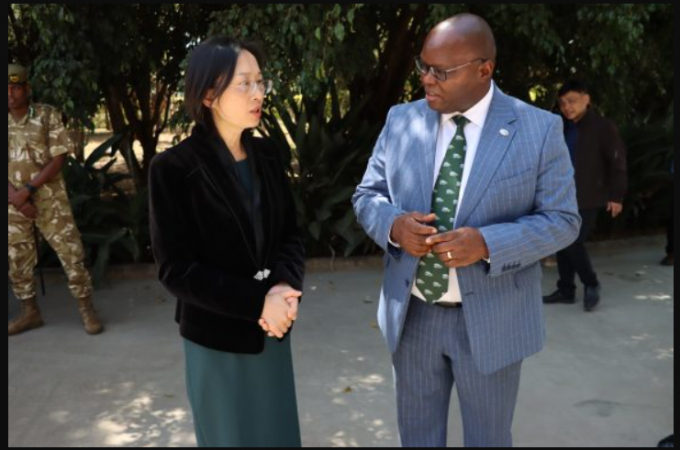
 Prof. Erustus Kanga, Director General of the Kenya Wildlife Service (KWS) (right) and Chinese Ambassador to Kenya, H.E. Guo Haiyan interact during the conference.
A long-running China-Africa scientific partnership based at Jomo Kenyatta University of Agriculture and Technology (JKUAT) is strengthening efforts to use research, training and technology to protect Africa’s biodiversity and support sustainable development.
The collaboration is anchored by the Sino-Africa Joint Research Centre (SAJOREC), established through cooperation between JKUAT and the Chinese Academy of Sciences (CAS). The centre has evolved into a platform for joint research on biodiversity conservation, environmental protection, sustainable agriculture and natural-resource management.
Rather than treating conservation as an isolated environmental issue, the partnership links biodiversity research with agriculture, climate change, ecological monitoring and scientific capacity-building, areas increasingly important to Africa’s development.
At the JKUAT campus in Juja, SAJOREC operates alongside a botanical garden and specialised laboratories supporting research into plant biosystematics, molecular biology, water resources, natural products, animal physiology, bioinformatics and biodiversity conservation.
The centre’s biodiversity work includes documenting African flora and fauna, developing biodiversity databases, identifying endangered species and investigating approaches for conserving species in their natural habitats. Its research also extends to agricultural innovation, including sustainable farming, soil management and crop improvement.
A major focus of the partnership is ensuring that scientific collaboration translates into stronger African research capacity.
SAJOREC supports training and exchanges between African and Chinese institutions, giving students and researchers opportunities to develop expertise through joint programmes, field research and postgraduate study. JKUAT has previously reported that more than 160 scientists and senior technicians from 13 African countries have received training through workshops and seminars, while nearly 150 postgraduate scholarships have supported advanced study.
The partnership has also helped create a generation of researchers able to work across Africa and China. Prof. Robert Wahiti Gituru, an Associate Professor of Plant Biosystematics at JKUAT and African Director of SAJOREC, has played a central role in developing the collaboration and has recommended more than 300 African students for postgraduate opportunities in China.
The collaboration also reflects a broader push to give African researchers greater access to advanced technologies and international scientific networks while keeping research rooted in African priorities.
For JKUAT, the China-Africa partnership demonstrates how international research cooperation can move beyond academic exchanges to create lasting infrastructure, expertise and scientific networks on the continent.
The partnership's longer-term significance may therefore lie not only in protecting species, but in strengthening Africa's ability to generate and apply the science needed to manage its natural resources for future generations.
photo courtesy: JKUAT
Article by Jed Mwangi
https://www.jkuat.ac.ke/china-africa-strengthen-biodiversity-research-and-conservation/
Comment