
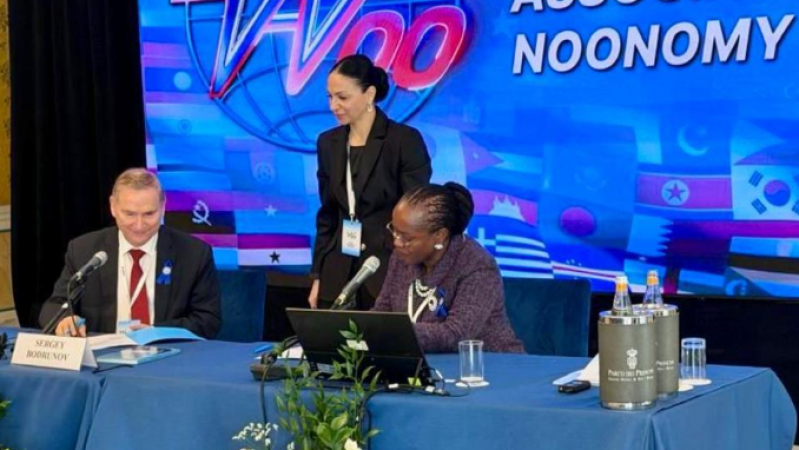
 Prof. Sergey Bodrunov (L) and Prof. Sarah Ssali (R) signing the MoU on 19th September 2026 in Rome, Italy.
Makerere University is positioning itself at the centre of Africa’s engagement with an emerging school of economic thought after signing a Memorandum of Understanding with the World Association of Noonomy to establish a Centre of Excellence for Noonomy.
The agreement, signed in Rome on 19 September 2026 during the World Congress on Noonomy, creates a framework for academic collaboration, research and teaching around the theory and is expected to lead to the establishment of a dedicated centre at Makerere’s College of Business and Management Sciences (CoBAMS).
Uganda was the only African country represented at the global congress, with a Makerere delegation led by Deputy Vice Chancellor for Academic Affairs Professor Sarah Ssali, CoBAMS Principal Professor Edward Bbaale and Lecturer Dr Peter Babyenda.
Makerere Vice Chancellor Professor Barnabas Nawangwe said the agreement effectively establishes an African Centre for Noonomy at the university, adding that it reinforces Makerere’s role in coordinating continental research initiatives.
The partnership follows an inaugural Noonomy conference held at Makerere on 20 August under the theme, “The Theory of Noonomy and its Role in Resolving Modernity Issues: Pathways to Sustainable Social and Economic Transformation.”
At the Rome congress, Makerere scholars presented research examining Noonomy’s relevance to development challenges in East Africa, the transition from informal to formal employment, and the role of universities in advancing the emerging field.
Developed by Russian scholar Professor Sergey Bodrunov, director of the S.Y. Witte Institute, Noonomy examines the evolving relationship between knowledge, technology, production and human development. It emphasises knowledge and human potential while placing humanistic values and solidarity within debates about economic and social progress.
Professor Ssali said the partnership gives African scholars an opportunity to engage with broader perspectives on political economy and question assumptions that have shaped economic thinking in recent decades. She said the university plans to launch its dedicated centre in February 2027.
Professor Bbaale, presenting research on Noonomy and development challenges in East Africa, said the approach could contribute to discussions on linking economic growth with social wellbeing and inclusive development.
Dr Babyenda said the theory’s human-centred approach broadens how development can be assessed, including consideration of wellbeing, consumption, knowledge transfer and the social implications of technologies such as artificial intelligence.
He also disclosed that Uganda has been offered an opportunity to host a future World Congress on Noonomy, potentially bringing together participants from more than 55 countries.
The partnership marks an effort to expand Africa’s participation in international debates over how economies should evolve, and to build a regional academic platform around a theory still taking shape globally.
Article by Jed Mwangi
Photo courtesy: Makerere University
Comment