
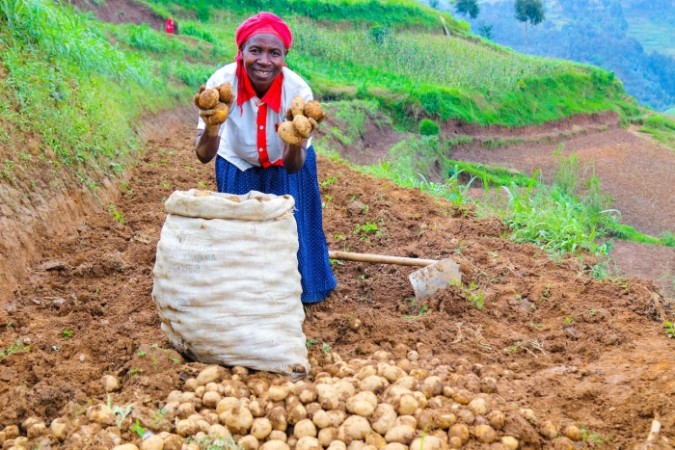
A new five-year, $15 million international agricultural initiative has been launched to enhance crop biotechnology and improve food security for Rwandan farmers through collaborative research and capacity building. Known as the Rwanda Capacity Building (BioCap) Project, the programme brings together global research institutions and national partners to strengthen Rwanda’s ability to develop, regulate and deploy improved crop varieties in response to persistent pests, diseases and climate-related stress.
The initiative is supported by the Bill & Melinda Gates Foundation and implemented through a consortium that includes the International Potato Center (CIP), the International Institute of Tropical Agriculture (IITA), Michigan State University, and Alliance for Science Rwanda. Together, the partners contribute expertise spanning genomics, plant breeding, biosafety regulation, policy engagement and farmer-focused extension systems, creating a comprehensive approach to agricultural biotechnology development.
Central to the project is the establishment of a Centre of Excellence for Crop Biotechnology at the Rwanda Agriculture and Animal Resources Development Board (RAB) Rubona Station in Huye District. The centre will serve as a national hub for advanced research, training and innovation, supporting the development of crop varieties tailored to Rwanda’s agricultural and environmental conditions.
Researchers based at the Centre will initially focus on three priority crops critical to Rwanda’s food security and rural livelihoods; cassava, potato and banana. These crops underpin household nutrition and farmer incomes but remain highly vulnerable to disease pressures and production losses.
“The Danforth Center is excited to be a partner in this important initiative to strengthen capacity for crop biotechnology in Rwanda,” said Nigel Taylor, PhD, Vice President of Impact and Dorothy J. King Distinguished Investigator at the Donald Danforth Plant Science Center. “This extends our existing collaboration with RAB to deliver virus-resistant cassava to smallholder farmers and reinforces our commitment to supporting Rwanda’s emergence as a leader in crop biotechnology in Africa.”
Rwanda’s agricultural sector continues to face mounting challenges, including emerging pests such as fall armyworm and mango mealybug, alongside longstanding crop diseases that significantly reduce productivity and farmer incomes. “Our agriculture sector continues to face serious challenges, including emerging pests and diseases such as cassava brown streak disease, potato bacterial wilt, banana Xanthomonas wilt, Fusarium wilt and drought stress,” said Solange Uwituze, State Minister in the Ministry of Agriculture and Animal Resources.
Through targeted investment, the BioCap Project will strengthen research infrastructure, expand scientific and technical human capacity, and support the generation of regulatory, environmental and food-safety data required for responsible biotechnology deployment. Scientists will also work to integrate improved crop varieties into national performance trials, seed systems and extension services, ensuring that laboratory breakthroughs translate into tangible benefits for farmers and communities.
Beyond individual crop improvements, the initiative seeks to build long-term national expertise and position Rwanda as a regional hub for crop biotechnology innovation. By training scientists, breeders and extension specialists, the Centre of Excellence is expected to foster a sustainable research ecosystem where innovation drives agricultural productivity, resilience and economic growth.
Photo courtesy / WFP/JohnPaul SESONGA
Article by Research Beeline reporter
Comment