
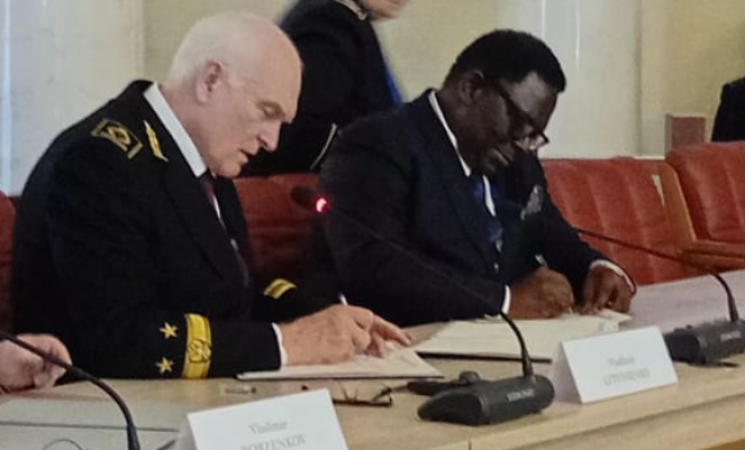
 Image of Secretary-General Prof. Olusola B. Oyewole, the university’s Rector, Prof. Vladimir Stefanovich Litvinenko signing the Agreement
The Association of African Universities (AAU) has established a representative office in Russia to expand academic partnerships, research collaboration and student mobility between African and Russian institutions, with a particular focus on engineering education and industrial development.
The office will be hosted by Empress Catherine II St. Petersburg Mining University and coordinated by the UNESCO Competency Centre for Mining Engineering Education under a five-year strategic agreement aimed at developing joint academic programmes, research projects and institutional partnerships.
The agreement was signed by AAU Secretary-General Prof. Olusola B. Oyewole, the university’s Rector, Prof. Vladimir Stefanovich Litvinenko, and UNESCO Competency Centre Director-General Prof. Vladimir T. Borzenkov during the second Russia–Africa Raw Materials Dialogue.
The new office is expected to provide a central platform for African universities seeking research partnerships, scholarship opportunities and specialised training in Russia, while supporting exchanges between academic institutions and industry.
One of the proposed initiatives is a flexible engineering education pathway that would combine five years of study in Africa with one year of advanced specialisation in Russia. The model is intended to strengthen technical skills while maintaining a strong connection between African universities and international expertise.
Plans are also under way to establish a Russia–Africa Academic Centre for Research and Human Capacity Development, spearheaded by St. Petersburg Mining University, the UNESCO Competency Centre and the AAU. The proposed centre would support joint research and skills development across priority sectors.
These include mining, energy, food security, digital technologies and public health, areas considered important to Africa’s industrialisation and economic transformation.
The partnership will also explore ways to improve the recognition of academic qualifications, facilitate credit transfers and strengthen quality assurance between institutions in the two regions. Such measures could help reduce administrative barriers to student mobility and make cross-border academic programmes easier to implement.
An additional proposal for an Academic Business Council seeks to strengthen links between universities and industry, particularly in technology transfer and the application of research to practical economic challenges.
Prof. Oyewole said the office represented a step towards internationalising African higher education and building partnerships that deliver tangible opportunities for students, researchers and institutions.
He emphasised the importance of equitable cooperation, with African and Russian partners working together to advance shared research and development priorities.
Ms. Alyona Krylova will serve as the Russian coordinator, while Mr. Ransford Bekoe will represent the AAU Secretariat in a dedicated working group responsible for programme and operational coordination.
The establishment of the office builds on the AAU’s regional office model in Europe and expands its international engagement. The association represents a membership of approximately 500 universities across Africa.
Photo courtesy:AAU
Article by Jed Mwangi
Comment