
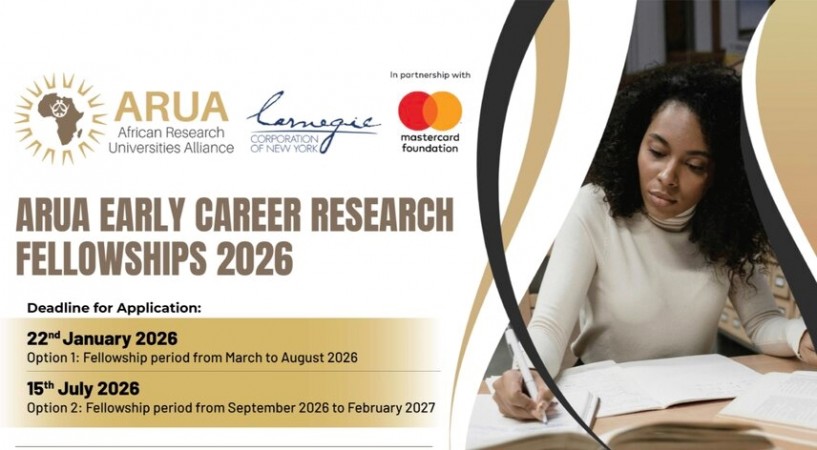
The African Research Universities Alliance (ARUA) has reaffirmed its eligibility criteria for its flagship early-career research fellowship programme, defending a contested age limit of 35 even as prospective applicants raised concerns that the rule may unfairly exclude qualified mid-career researchers.
The age-limit question dominated a virtual information session held on 17 January 2026, which was intended to walk applicants through fellowship eligibility and the application process. Instead, most questions during the briefing focused on whether the age restriction is appropriate in an African context where many researchers begin doctoral studies or research careers later in life.
Under the ARUA fellowship guidelines, candidates must satisfy two conditions: be no older than 35 at the time of application and be within five years of completing a PhD. ARUA’s Jane Ambuko, Director of Research and Training, explained that the two conditions are intended to align with the programme’s goal of supporting “early-career researchers at similar stages of professional development.”
However, several participants pushed back, noting that many African academics do not follow a traditional trajectory that leads to early PhD completion. One attendee, a former engineer now pursuing research, described being excluded at 36 as “disheartening,” arguing that age does not necessarily reflect a researcher’s potential or energy to contribute meaningful science.
Another prospective applicant, identified, questioned whether a strict age cutoff should outweigh the quality of a research idea. “So if you have a very brilliant idea, you have the energy to do the research and you’re a little bit over 35, should you not put in an application?” she asked.
Responding to the concerns, John Gyapong, ARUA’s Secretary-General, reiterated that the age limit is tied to funder conditions and is therefore not subject to internal modification. “Unfortunately, we cannot change that,” Gyapong said during the session, noting that the majority of fellowship funding comes from the Mastercard Foundation, a partner that has historically prioritised youth-focused investments.
Gyapong explained that the age limit of 35 is a stipulation of the primary funding stream, and compliance is necessary to release and sustain support. “The line that has been drawn is … 35,” he said, adding that exceptions were limited by funder requirements.
The alliance pointed to a narrow exception for a smaller number of fellowships funded by the Carnegie Corporation of New York, which do not carry the same age restriction. However, Gyapong noted that eligibility for Carnegie-supported slots does not extend to male applicants above the threshold, and overall opportunities under this stream are limited.
Despite the rigid cutoff, ARUA officials encouraged applicants who narrowly miss the age threshold to submit proposals, suggesting that flexibility in the review process may allow for exceptional cases to be considered under specific conditions.
“We are not discouraging anyone who is slightly above the age limit,” Gyapong said. “Just throw your proposal in there for it to be considered.”
Early-career fellowships are widely seen as crucial for developing locally led research capacity, yet standardised cutoffs such as age limits can inadvertently exclude those who have followed non-linear academic paths, common in contexts where socio-economic factors, access to education, and early career disruptions vary widely.
Photo courtesy / Google
Article by Jed Mwangi
https://arua.org/arua-hosts-maiden-information-webinar-for-early-career-researchers-in-africa/
Comment