
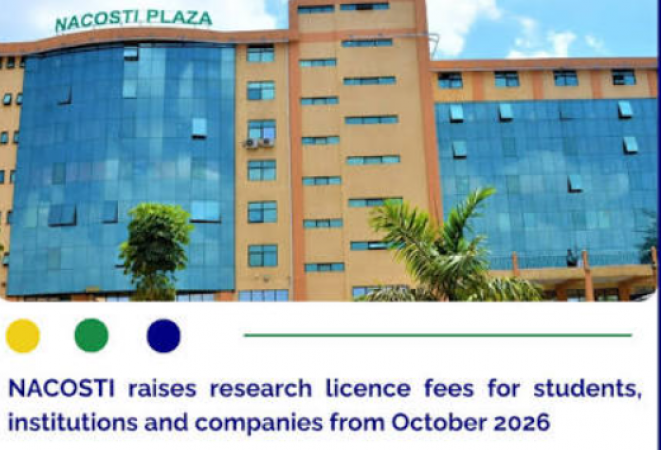
The cost of conducting research in Kenya is set to rise sharply from October, with new licensing charges increasing the financial burden on students, researchers and institutions seeking regulatory approval for studies in the country.
The National Commission for Science, Technology and Innovation (NACOSTI) will introduce the revised fees on October 1, 2026, under a new schedule published in the Kenya Gazette. The changes mark the first major revision of research licensing fees in 17 years and affect applicants ranging from diploma students to international clinical-trial sponsors.
For Kenyan citizens and nationals of East African Community partner states, some of the largest increases will affect postgraduate researchers. A Master's research licence will rise from Sh1,000 to Sh6,000, while PhD researchers will pay Sh10,000, up from Sh2,000. Postdoctoral and individual researchers will pay Sh15,000, compared with the previous Sh5,000.
Undergraduate and diploma researchers will also face significantly higher charges. Diploma-level licences will increase from Sh100 to Sh1,000, while degree-level applications will rise from Sh100 to Sh2,000. Expedited processing will attract additional charges across the categories.
Research institutions and companies face higher fees as well. Institutional applications will cost Sh30,000, or Sh50,000 for expedited processing, while companies will pay Sh50,000 or Sh70,000. The revised schedule also introduces or maintains substantially higher dollar-denominated charges for researchers and organisations outside the EAC.
The increases could have implications for Kenya’s research ecosystem, particularly for universities and students who often operate with limited research budgets. For postgraduate students, licensing is one of several costs associated with conducting fieldwork, alongside data collection, travel, equipment and institutional research fees.
Internationally funded research could also become more expensive. Researchers from outside the EAC will pay in US dollars under the new schedule, with Master's applicants charged US$400 for standard processing and US$500 for expedited review. Clinical trials will attract a US$1,000 licensing fee.
NACOSTI has linked the increases to the rising cost of carrying out its regulatory responsibilities. Following a stakeholder forum held in February 2026, the commission said existing charges had not kept pace with the costs of reviewing applications, monitoring compliance and maintaining research information systems.
The financial impact may extend beyond initial applications because research licences are valid for one year. Projects that continue beyond that period require renewal, with renewals charged at the applicable licence rate. NACOSTI also states that licensing fees are non-refundable.
The new structure nevertheless preserves preferential treatment for EAC researchers through lower local-currency charges, potentially reinforcing regional research collaboration while creating a wider cost differential for researchers from outside the bloc.
For Kenya, the fee revision comes as the country seeks to expand its research and innovation ecosystem and attract international scientific collaborations. How the higher regulatory costs affect student participation, institutional research budgets and foreign-funded studies will depend partly on whether universities and funders absorb the additional expense or pass it on to researchers.
The changes therefore represent more than an administrative fee adjustment: they alter the cost of accessing Kenya as a research environment at a time when the country is seeking to strengthen its position as a regional centre for science and innovation.
Article by Jed Mwangi
photo courtesy:google
Comment