
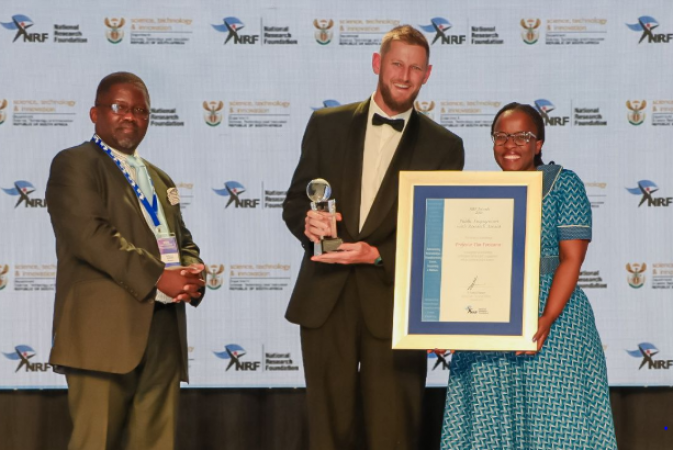
South Africa’s push to transform its research system took centre stage at the 2026 National Research Foundation (NRF) Awards, with calls for scientific excellence to be matched by wider access to research funding, stronger institutions and greater impact on society.
The awards, held in Gqeberha in the Eastern Cape on September 3, recognised leading researchers for contributions ranging from pandemic preparedness and medical technologies to postgraduate training and policy. But the ceremony also highlighted persistent inequalities in where research resources are concentrated across the country’s higher education system.
Higher Education, Science and Innovation Minister Blade Nzimande said transforming the national research system was essential to ensuring South Africa makes full use of its limited resources. He pointed to the concentration of funding among a small group of universities as a continuing challenge to broader participation in research.
About 63 per cent of NRF funding currently goes to the country’s 10 highest research-output universities, while 83 per cent of South African Research Chairs Initiative (SARChI) Chairs are hosted by top-output institutions. Nzimande said expanding research capacity beyond these universities was necessary to unlock scientific potential across the country.
Earlier in 2026, the NRF awarded 41 new SARChI Chairs specifically to historically disadvantaged institutions, universities of technology and newer universities. It has also begun implementing the University Programmes and Collaborations initiative, which provides tailored interventions aimed at strengthening research and human-capital capacity at historically disadvantaged institutions.
The awards themselves reflected another shift in South Africa’s research agenda: increasing emphasis on what research changes outside academia. NRF Acting CEO Dr Angus Paterson said the organisation introduced the Societal Impact Award in 2024 to recognise research demonstrating tangible benefits to communities and the wider public.
This year’s Societal Impact Award went to Professor Tulio de Oliveira of Stellenbosch University’s Centre for Epidemic Response and Innovation and Dr Cobus van Breda of the University of the Free State. Their recognition came alongside honours for researchers whose work contributed to COVID-19 responses, advanced drug-delivery technologies and strengthened the country’s research workforce through postgraduate supervision.
Lifetime achievers Professor Jonathan Jansen and Professor Hellen Rees were among the prominent figures honoured, while the NRF also highlighted the growing recognition of women and early-career researchers.
NRF Board Chair Professor Ari Sitas said mentorship, capacity building, interdisciplinary collaboration and inclusive participation were increasingly important to building a representative research system. The awards, held under the theme “Building an Inclusive, Impactful and Transformed Research Future”, were therefore framed not only as recognition of scientific achievement but as a reflection of where South Africa wants its research system to go.
The message from the ceremony was clear: excellence remains central to South Africa’s scientific ambitions, but excellence alone is no longer enough. The country is increasingly measuring the strength of its research system by who gets to participate, where capacity is built and whether knowledge ultimately improves lives.
Article by Jed Mwangi
Photo courtesy:NRF
https://www.nrf.ac.za/the-2026-nrf-awards-celebrate-south-africas-research-and-science-stars/
Comment