
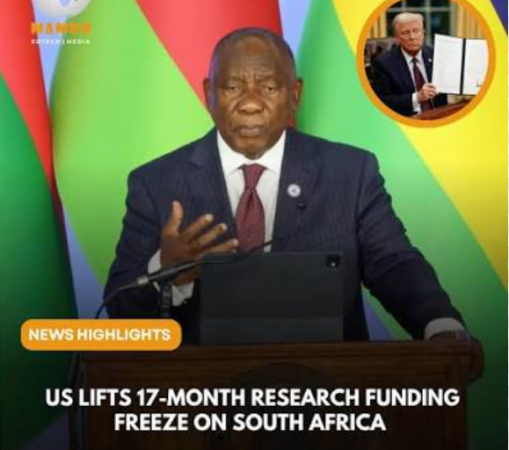
The United States National Institutes of Health (NIH) has cleared the way for research projects in South Africa to resume, easing months of uncertainty over one of the most important channels of US-Africa scientific collaboration.
The decision means meritorious NIH-funded research in South Africa can proceed, subject to scientific review, US State Department scrutiny and other NIH requirements, according to an internal memo from NIH Director Dr Jay Bhattacharya reported by Science.
The move effectively separates NIH-supported scientific research from the broader US restrictions on foreign assistance to South Africa introduced by President Donald Trump in February 2025.
In his memo, Bhattacharya argued that NIH grants should not be treated as conventional foreign aid because their purpose is to support international scientific collaboration and generate knowledge with broader health implications.
The clarification is particularly significant for South Africa, which has long been an important partner in US-supported research on HIV, tuberculosis and other major public health challenges.
Under the new guidance, South African research projects can move forward where they demonstrate a clear scientific justification for being conducted outside the United States.
Projects must also have the potential to generate knowledge relevant to understanding, improving or protecting the health of Americans.
The NIH maintains that Congress has specifically authorised the agency to participate in international research collaborations and that its research funding mechanisms are not governed by the Foreign Assistance Act.
The distinction provides a pathway for scientific partnerships to continue even as broader political tensions between Washington and Pretoria persist.
For universities and research institutions in South Africa, the decision could help restore greater certainty around internationally funded research programmes and collaborations involving US scientists and institutions.
The original US restrictions followed an executive order issued by President Trump that instructed federal agencies to halt, to the maximum extent permitted by law, foreign aid or assistance to South Africa.
The order cited disagreements with South Africa over land policy and its legal action against Israel at the International Court of Justice.
However, the NIH has now determined that its research grants fall into a different category.
The agency's decision comes against the backdrop of a long-standing scientific relationship between the US and South Africa. Researchers in both countries have collaborated extensively on infectious diseases, epidemiology, clinical research and other areas of global health.
The reopening of NIH-funded research therefore extends beyond individual grants. It preserves a scientific partnership that has helped generate evidence on diseases affecting both African and global populations.
At the same time, the new policy introduces an additional condition: international research must demonstrate a direct scientific rationale and relevance to US health interests.
This could influence how future projects involving South African institutions are designed and evaluated.
Nevertheless, the decision represents an important reopening of the US research funding pathway to South Africa, allowing scientific collaboration to continue despite wider diplomatic and political disagreements.
photo courtesy: Africa Equity Media
Article by Jed Mwangi
https://healthpolicy-watch.news/nih-lifts-ban-on-research-in-south-africa/
Comment