
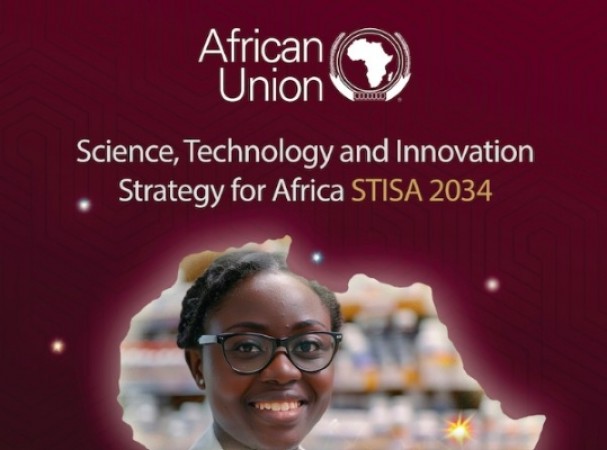
The African Union has formally launched the implementation plan for the Science, Technology and Innovation Strategy for Africa (STISA-2034), setting out an ambitious 10-year roadmap that will require an estimated US$6.8 billion to strengthen the continent’s science and innovation ecosystem.
The plan was unveiled during the AU’s STI Week, which concluded in Addis Ababa on 12 February. It outlines concrete steps to operationalise the long-anticipated African Education, Science, Technology and Innovation (AESTI) Fund, a central financing mechanism intended to ensure sustainable support for continental research and innovation programmes.
The new implementation framework follows a review of the earlier STISA-2024 strategy, whose final report called for the urgent establishment of a dedicated funding mechanism to address chronic underinvestment in Africa’s science sector. STISA-2034 is designed to build on that foundation by scaling programmes, improving coordination and strengthening the commercialisation of African research.
The strategy prioritises five core sectors considered critical to the continent’s development: agriculture, health, energy, information and communication technologies (ICT), and environmental sustainability. These priorities are reinforced by six cross-cutting themes, including industrialisation, human capital and infrastructure development, emerging technology capabilities, science diplomacy, strategic partnerships, and closing youth and gender gaps.
Implementation will unfold in two phases. Phase One, covering 2025–2029, focuses primarily on aligning existing STI flagship programmes, developing new initiatives and operationalising the AESTI Fund. This phase is budgeted at US$2.6 billion, with US$1.2 billion earmarked specifically to modernise existing facilities, enable digital platforms and strengthen institutional systems across AU member states.
Rather than prioritising large new infrastructure projects, the first phase emphasises upgrading and expanding current capacity while establishing regulatory frameworks and building human capital needed to support innovation ecosystems.
Phase Two, running from 2030 to 2034, will require US$4.2 billion and is expected to significantly scale research activities, innovation hubs and commercialisation efforts across the continent.
To finance the strategy, the implementation plan proposes multiple funding mechanisms. A Committee of 10 Presidents will be tasked with spearheading resource mobilisation and activating the AESTI Fund. The committee is expected to convene annual roundtables bringing together AU member states, private sector actors and development partners.
The plan also assigns key roles to the African Union Development Agency-NEPAD (AUDA-NEPAD) and the African Union Commission, which will jointly market funding proposals to international donors and private foundations. Regional Economic Communities are expected to align their own STI strategies with STISA-2034 while leveraging domestic and external financing.
Additional funding avenues identified include partnerships with the European Union, the United Nations, the G20, the World Bank, and the African Development Bank, alongside expanded South-South cooperation with countries such as China, India and Brazil.
Momentum behind the strategy has already begun to build. On 14 February, AUDA-NEPAD announced that the Science Granting Councils Initiative (SGCI) would contribute US$42 million to support STISA-2034 implementation between 2026 and 2030.
The SGCI partnership, involving science funding agencies from 20 Sub-Saharan African countries, aims to boost the production of high-quality, Africa-led research and scale innovations addressing development challenges. The initiative will particularly support multi-country programmes in the strategy’s priority sectors while helping attract additional investment.
Beyond financing, the implementation plan proposes new oversight mechanisms. A Specialised Technical Committee on Education, Science and Technology will be established as an AU policy organ to supervise execution of the strategy.
Member states will be required to designate national focal points responsible for reporting progress and integrating the strategy into domestic development frameworks.
Speaking at a news conference, AU Commissioner for Education, Science, Technology and Innovation Gaspard Banyankimbona described the implementation plan as a “decisive paradigm shift” for the continent.
He urged member states to increase national investment in research and development to at least 1% of GDP, establish national innovation hubs and fully domesticate STISA-2034 within their development strategies.
If fully implemented, STISA-2034 could mark one of the most significant coordinated pushes yet to position science, technology and innovation at the centre of Africa’s economic transformation.
Photo courtesy / AU
Article by Jed Mwangi
Comment