
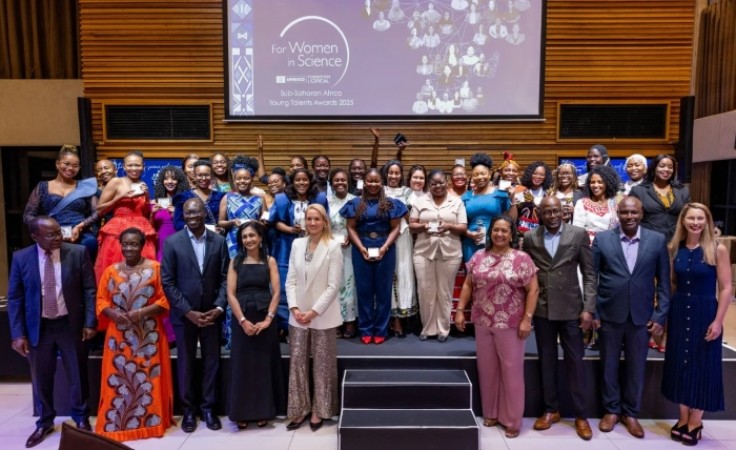
 Group photo of the winners in Johannesburg
Thirty outstanding young women scientists from Sub-Saharan Africa have been honoured with the 2025 L’Oréal-UNESCO For Women in Science Young Talents Awards, marking the 16th edition of the regional programme that recognises emerging scientific excellence across the continent.
Jointly organised by Fondation L’Oréal and UNESCO, the awards celebrate 25 PhD candidates and five postdoctoral researchers from 18 countries, whose work spans life and environmental sciences, engineering and technology, material sciences, and formal sciences. The laureates were selected from a competitive pool of more than 550 applicants, following a rigorous evaluation by an independent scientific jury chaired by Professor Priscilla Baker, herself a 2025 L’Oréal-UNESCO Laureate.
This year’s cohort has been recognised for research addressing some of Africa’s most pressing challenges, including food security, public health, sustainable development, and inclusive digital transformation, all closely aligned with the United Nations Sustainable Development Goals. Beyond advancing scientific knowledge, the laureates’ work offers practical, scalable solutions with the potential to deliver tangible benefits for communities across the continent.
Among the 2025 awardees is Margaret Murage (Kenya), recognised for her pioneering research into novel cancer therapies, and Ramal Cyrielle Ndougonna (Chad), whose work uses genomic data to identify cassava varieties that are disease-resistant, nutrient-enhanced, and adaptable to Africa’s increasingly arid climates, an innovation critical to strengthening food security.
The other 2025 winners include Darlenne Kenga and Tamara José Sande (Mozambique); Effita Fifi Masoamphambe (Malawi); Keneuoe Cecilia Nthontho (Lesotho); Kelebonye Ramolekwa and Dineo Pono Sebuso (Botswana); Lakshmi Yaneesha Sujeeun (Mauritius); Claude Yasmine Hamany Djande, Christelle Mbouteu, Onella Mundi Nnandi Noukou, and Nelly Manuela Tchatchoua Tatchoua (Cameroon); Fana Gebremichael, Seble Kebede, and Tigist Addisu (Ethiopia); Cesilia Mambile, Godiana Hagile Philipo, and Rehema Mwawado (Tanzania); Sarah Nawoya (Uganda); Maame Ekua Acquah (Ghana); Fekandine Victoire Douti (Togo); Aminata Sarr (Senegal); Afrah Khairallah (South Africa); Miranda Mpeta (Zimbabwe); and Maurine Chepkoech (Kenya). Hamidat Alaka, Modupe Stella Ayilara, Blessing Chioma Oselu, and Oluwatosin Ajayi (Nigeria)
Pauline Avenel-Lam, Executive Director of Fondation L’Oréal, said the awards underscore the strategic importance of supporting women scientists, describing the cohort as “pioneering sustainable change and delivering solutions for Africa and the world.” Lidia Brito, UNESCO’s Assistant Director-General for Natural Sciences, added that the programme amplifies women researchers’ voices at the heart of Africa’s scientific transformation.
The programme, part of a broader global effort by L’Oréal and UNESCO to promote gender equality in science, has a longstanding record of elevating women researchers’ profiles and careers. Since its inception 15 years ago, it has already supported more than 270 women scientists from more than 35 countries. Each laureate receives a financial grant (€10,000 for PhD candidates and €15,000 for postdoctoral researchers) and is provided with essential training in leadership, scientific communication, and career development. Additionally, they join a global network of over 4,700 women scientists, establishing connections that promote collaboration and knowledge sharing.
Photo courtesy / L'oreal
Article by Jed Mwangi
Comment