
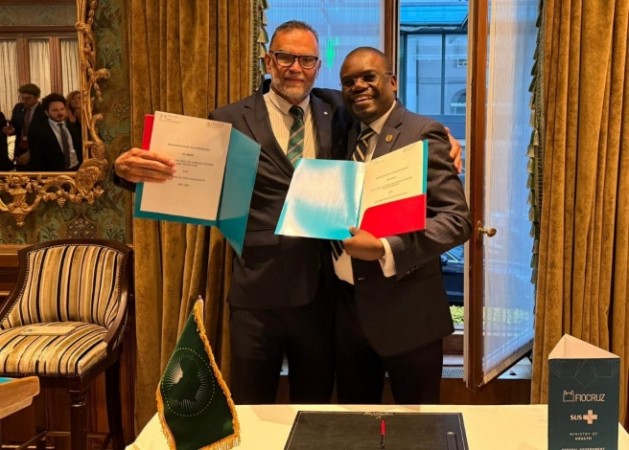
In a major boost for Africa’s public health ambitions, the Africa Centres for Disease Control and Prevention (Africa CDC) has signed a landmark cooperation agreement with Brazil’s Oswaldo Cruz Foundation (Fiocruz), Latin America’s leading biomedical research institute. The pact, signed during the 78th World Health Assembly in Geneva, marks a pivotal South-South partnership aimed at transforming Africa’s health systems and fortifying regional preparedness against emerging health threats.
The Memorandum of Understanding (MoU) was signed by Africa CDC Director-General Dr. Jean Kaseya and Fiocruz President Dr. Mario Santos Moreira. It outlines a comprehensive framework for collaboration in areas such as strengthening National Public Health Institutes (NPHIs), improving disease surveillance using the One Health approach, supporting emergency preparedness legal frameworks, and advancing local vaccine and pharmaceutical manufacturing on the continent.
“This MoU goes beyond symbolic diplomacy; it is a commitment to reshaping how the Global South responds to health threats,” said Dr. Kaseya. “Together with Fiocruz, we are charting a course for Africa to lead with strength, equity, and preparedness.”
With just 1% of the vaccines used in Africa currently produced on the continent, the partnership is seen as a significant step toward reducing reliance on global supply chains. Fiocruz, with its vast experience in global health diplomacy and pharmaceutical production, is expected to provide critical technical support in technology transfer, research collaboration, and workforce development.
Though the agreement does not include immediate financial disbursements, it establishes a Joint Action Plan supported by technical working groups. These teams will guide implementation, monitor progress, and ensure continuous knowledge exchange.
The deal is also a cornerstone of Africa CDC’s broader “New Public Health Order,” which seeks to promote health sovereignty, innovation, and regional self-sufficiency. The timing is urgent: Africa faces rising health and economic vulnerabilities, and projections suggest millions could fall into poverty by 2030 due to weak health infrastructure and future pandemics.
With over 25 vaccine manufacturing projects underway across Africa and a goal of WHO prequalification for eight key antigens by 2030, the partnership with Fiocruz strengthens the continent’s momentum toward health independence. Observers say this collaboration exemplifies a growing trend in global health governance—one that prioritises regional solidarity, equitable partnerships, and co-investment from the Global South.
As Dr. Kaseya affirmed, “This is more than an agreement—it’s a movement toward a new era in African public health leadership.”
Article by Jed Mwangi
Photo/Google
https://africacdc.org/news-item/africa-cdc-and-fiocruz-partner-to-strengthen-health-systems/
Comment