
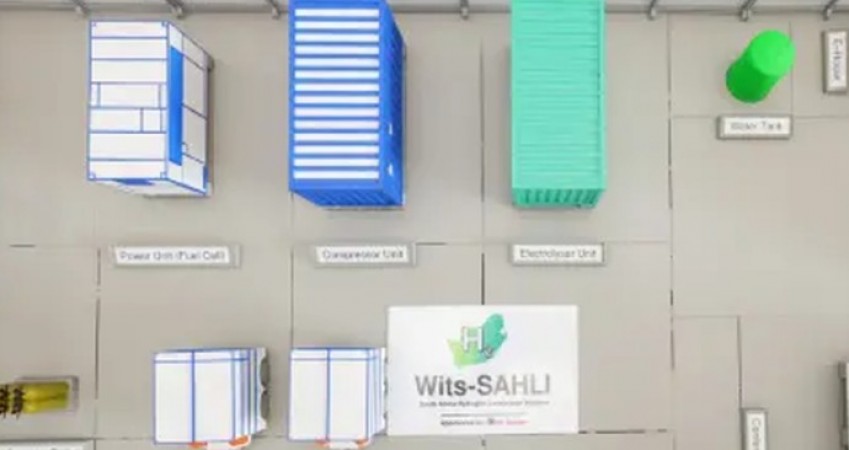
A landmark hydrogen production facility has been launched at University of the Witwatersrand (Wits University), marking a significant step forward in South Africa’s transition to a low?carbon economy and reinforcing the institution’s role as a hub for scientific innovation and industrial development.
The R100?million modular hydrogen plant, scheduled to become fully operational by 2028, will function as a “living laboratory” where researchers, students and industry partners can explore practical applications of green hydrogen technologies.
Unlike traditional pilot facilities that remain confined to theoretical research, the plant combines applied research, teaching and real?world testing, allowing on?campus experimentation with hydrogen production and usage. The plant harnesses solar electricity to split water into hydrogen through electrolysis, a process that, when powered by renewables, produces low?carbon hydrogen. At full output, it can generate around 2.2?kg of hydrogen per hour and store up to 200?kg of the gas onsite.
Once operational, the hydrogen produced at the facility will serve multiple purposes: powering certain campus energy needs, supporting hydrogen?powered transport projects and enabling technical trials for industry partners seeking to integrate hydrogen solutions into their operations.
The plant represents a public?private partnership between Wits University, global industrial gases company Air Liquide South Africa, and the Localisation Support Fund, all working together to strengthen local research capacity and build a skilled workforce prepared for the emerging hydrogen economy.
For Wits University, the facility aligns with its broader strategy of fostering innovation that directly responds to national and regional priorities. Professor Zeblon Vilakazi, Vice?Chancellor and Principal of Wits, noted that the initiative reflects the university’s commitment to advancing knowledge frontiers while preparing students to lead in new industrial sectors.
Deputy President Mashatile highlighted the plant’s significance to South Africa’s broader green energy ambitions, describing the project as a potential catalyst for reindustrialisation and technological self?reliance. By investing in local hydrogen research and production capabilities, the country aims to reduce dependence on imported technologies and build a domestic supply chain that supports jobs, innovation and economic growth.
The facility also complements recent national advances in hydrogen education and workforce development. Earlier initiatives approved new qualifications in green hydrogen production, storage and technology, strengthening the pipeline of skilled professionals needed for the sector’s growth.
As the hydrogen facility takes shape over the coming years, its influence is expected to extend beyond academia. By serving as a testing ground for new technologies and as a training hub for engineers and researchers, the plant embodies a practical model for how higher education institutions can drive innovation that supports both local development and global sustainability goals.
Photo courtesy / FWC
https://hydrogen-central.com/new-hydrogen-plant-at-wits-university-to-power-research/
Comment