
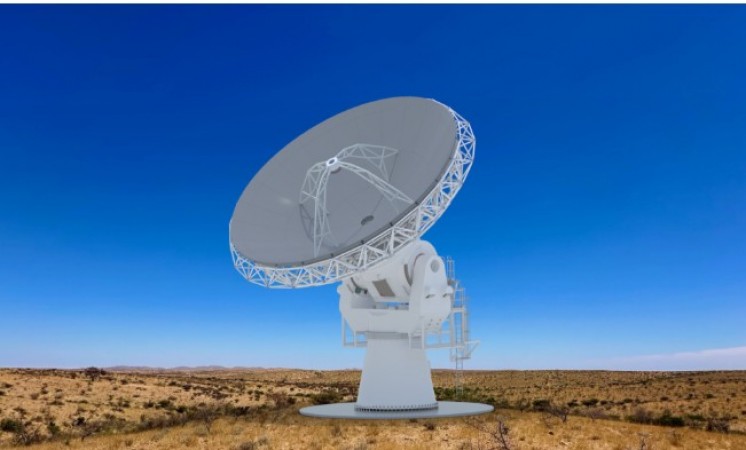
South Africa and Namibia have strengthened their scientific cooperation through a new partnership aimed at advancing the Africa Millimetre Telescope (AMT) project, an ambitious initiative expected to elevate the continent’s role in cutting-edge global astronomy and space science.
The agreement, formalised between the University of South Africa and the University of Namibia, reflects a growing commitment by African institutions to jointly develop world-class research infrastructure while nurturing scientific talent across borders. The collaboration was reinforced during a high-level visit to Namibia in February 2026, bringing together academic leaders, researchers, and students in astrophysics.
At its core, the partnership signals a broader shift toward African-led ownership of large-scale scientific projects. Leaders involved in the initiative emphasized that the AMT is not only a research facility but also a symbol of the continent’s ambition to contribute meaningfully to global knowledge production.
The telescope will be constructed in Namibia’s Khomas Highlands, a location selected for its high altitude, dry climate, and minimal radio interference,conditions ideal for advanced astronomical observations.
Once completed, the AMT will become Africa’s first millimetre-wavelength radio telescope, marking a significant milestone in the continent’s scientific development.
The AMT is expected to play a critical role in the global Event Horizon Telescope network, the international collaboration responsible for capturing the first-ever image of a black hole in 2019. By filling a geographical gap in the Southern Hemisphere, the African telescope will enhance the network’s imaging precision and ability to observe fast-changing cosmic phenomena.
Scientists say the addition of the AMT will significantly improve the resolution and coverage of global observations, enabling more detailed studies of black holes and other extreme cosmic events. This positions Africa not just as a participant, but as a critical contributor to frontier astrophysics research.
Beyond its scientific capabilities, the partnership places strong emphasis on capacity building and postgraduate development. The collaboration will support student training, academic exchange, and long-term research cooperation between institutions in both countries.
This focus on human capital development reflects a recognition that sustainable scientific progress depends not only on infrastructure but also on cultivating a new generation of African scientists equipped to lead future discoveries.
The AMT project builds on a growing ecosystem of major scientific investments across the continent, including radio astronomy initiatives and international collaborations. By leveraging regional partnerships, African institutions are increasingly positioning themselves within global research networks that tackle some of the universe’s most complex questions.
Funding for the telescope’s construction is supported by international partners, including the European Research Council and the Dutch Research Council, alongside African institutions, highlighting a model of shared global investment with strong local leadership.
As construction plans advance, the South Africa–Namibia partnership reflects a broader continental vision: one where Africa not only participates in global science but helps shape its direction.
Photo courtesy / Event Europe Telescope
Comment