
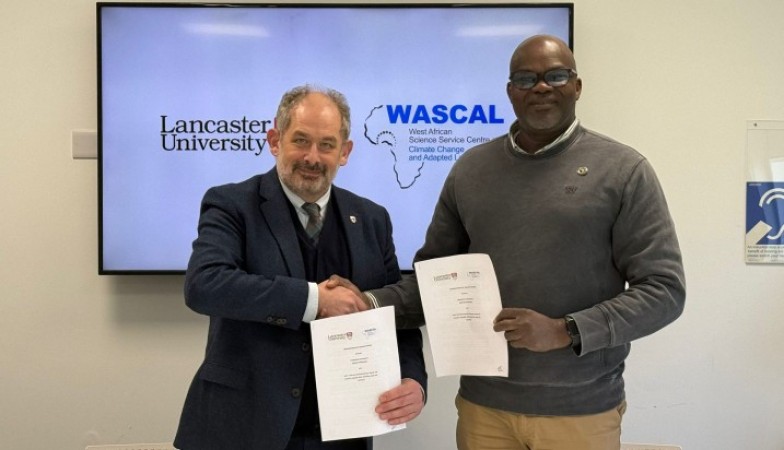
The collaboration between the West African Science Service Centre on Climate Change and Adapted Land Use (WASCAL) and Lancaster University is emerging as a model for how African institutions are repositioning themselves within global research networks to tackle climate change through coordinated, large-scale partnerships.
The partnership, formalised through a five-year memorandum of understanding, builds on WASCAL’s active participation in the Africa Research and Innovation Partnership (ARIP), a platform hosted by Lancaster University that brings together institutions from across Africa and Europe.
Rather than focusing solely on academic exchange, the partnership reflects a broader shift toward strategic alignment in research priorities and funding mobilisation. Through ARIP, WASCAL joined a network of universities and research institutions spanning countries including Ghana, Nigeria, Kenya, Rwanda, and South Africa, alongside European partners, to co-develop solutions to climate and development challenges.
This approach emphasizes early-stage collaboration—where institutions jointly design research proposals, align expertise, and build competitive consortia capable of securing large-scale international funding. One of the key areas of focus emerging from the partnership is the water–nutrient–energy nexus, a critical component of sustainable and climate-smart agriculture systems in Africa.
A central objective of the WASCAL–Lancaster collaboration is to strengthen Africa’s participation in major global funding frameworks such as Horizon Europe, where competition for research grants is increasingly driven by well-coordinated international consortia.
By engaging in structured platforms like ARIP, African institutions are moving beyond fragmented research efforts toward collective, high-impact proposals that address continental priorities while meeting global scientific standards. This model not only enhances access to funding but also ensures that African research agendas are shaped from within the continent rather than externally imposed.
The partnership also highlights a growing recognition that scientific capacity is best built through interconnected networks rather than isolated institutions. The ARIP engagement facilitated collaboration among academic leaders, researchers, and policymakers, enabling knowledge exchange and the formation of long-term institutional relationships.
For WASCAL, whose mandate focuses on strengthening climate research and resilience in West Africa, the collaboration provides a platform to expand its influence beyond the region while reinforcing its role as a hub for climate science, training, and policy engagement.
Beyond academic outcomes, the partnership is designed to ensure that research outputs contribute to practical, policy-relevant solutions. By integrating interdisciplinary expertise and aligning research with development priorities, the collaboration aims to address pressing issues such as climate adaptation, food security, and sustainable resource management.
Photo courtesy / WASCAL
Comment